
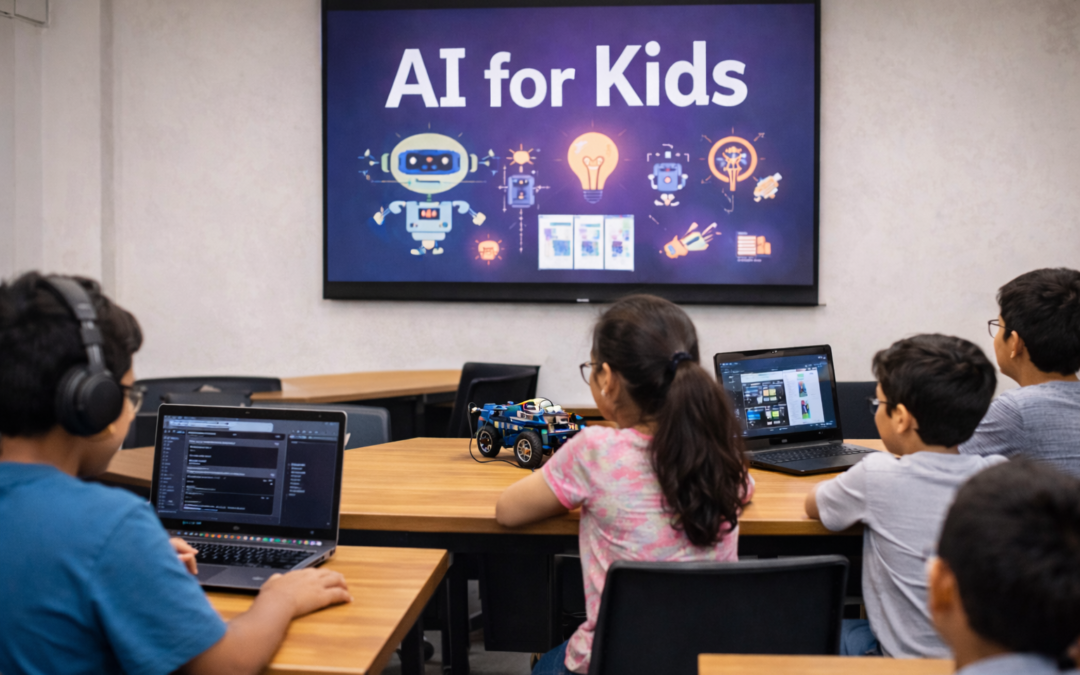
Best AI Course for Kids With Practical Learning is not about watching tutorials or memorising definitions. It is about doing, building, experimenting, and understanding Artificial Intelligence through hands on experience. When children learn by creating, the learning stays with them. When they only observe, the understanding fades.
AI for Kids by Digital Scholar is designed around practical learning from the very first session. It is a 4 week weekend AI program created specifically for school students from Grades 4 to 12. The focus is simple. Teach children what AI is, show them how it works, and let them build real projects with confidence.
Contents
- 1 Why Practical Learning Matters in AI Education
- 2 A 4 Week Program Designed Around Doing
- 3 Week 1: Understanding Before Application
- 4 Week 2: Turning Ideas Into Projects
- 5 Week 3: Applying AI in Creative Ways
- 6 Week 4: Building a Simple AI Agent
- 7 Real Outcomes That Reflect Practical Growth
- 8 Graduation and Project Showcase
- 9 Trainers Guiding Practical Learning
- 10 Learning Support Beyond Live Sessions
- 11 Proven Experience in Teaching AI Practically
- 12 Who Should Join
- 13 Program Details and Enrollment
- 14 Why This Is the Best AI Course for Kids With Practical Learning
Why Practical Learning Matters in AI Education
Artificial Intelligence is not a subject that should remain theoretical. It is dynamic, interactive, and creative. Children understand technology best when they actively use it in structured ways.
Practical learning helps students:
- Connect concepts to real applications
- Build logical thinking
- Develop problem solving skills
- Gain confidence through visible results
- Learn responsibility through guided usage
The Best AI Course for Kids With Practical Learning must ensure that every concept is applied immediately. This program follows that approach carefully.
A 4 Week Program Designed Around Doing
The program runs for one month with 8 live sessions conducted every Saturday and Sunday from 5 PM to 7 PM. Students can attend online via Zoom or offline at the Digital Scholar campus in Chennai.
The structure ensures:
- Live interaction and guided activities
- Immediate application of concepts
- Continuous building of projects
- Reflection and improvement week by week
Practical learning is woven into every class.
Week 1: Understanding Before Application
Practical learning does not mean rushing into tools. It begins with clarity.
In Week 1, students explore:
- What Artificial Intelligence truly means
- The difference between AI, Machine Learning, and Generative AI
- How Large Language Models work
- Types of AI models used in real world scenarios
- Safe AI ethics and responsible usage
- Structured prompting using the CRAFT framework
Even during foundational learning, students practice interacting with AI in a structured way. They test prompts. They observe responses. They refine questions.
This early practice builds confidence and discipline.
Week 2: Turning Ideas Into Projects
The second week transforms understanding into action.
Students use AI to improve communication and presentation skills. They create AI powered presentations using structured thinking. They learn how to organize ideas logically and express them clearly.
In the next session, they build simple AI powered websites without coding. They also create mini apps and games using AI and no code tools.
Practical outcomes in Week 2 include:
- A working AI powered presentation
- A basic website built independently
- A simple interactive app or game
- Logical problem solving experience
Students experience the satisfaction of building something that functions.
Week 3: Applying AI in Creative Ways
Week 3 expands practical learning into creative territory.
Students create AI visuals and storytelling content. They build short AI documentaries using structured frameworks. They explore how advertisements and digital media are produced.
Through hands on creation, students understand:
- How AI supports visual design
- How storytelling structure shapes communication
- How digital media influences audiences
- How to combine creativity with responsibility
Practical learning here means producing something original rather than copying examples.
Each project strengthens creative confidence.
Week 4: Building a Simple AI Agent
The final week introduces students to AI agents and automation.
They learn what AI agents are in simple language. Then they build their own basic AI agent step by step.
This hands on process allows students to see how instructions become automated systems. They understand that AI can follow structured logic.
By the end of Week 4, practical learning has resulted in:
- Real digital creations
- Understanding of automation
- Systems thinking
- Confidence in advanced ideas
The Best AI Course for Kids With Practical Learning ensures that even complex topics are explored through action.
Real Outcomes That Reflect Practical Growth
Across the four weeks, students create:
- AI powered presentations
- A short AI documentary
- No code AI websites
- Simple apps and mini games
- Creative AI visuals and advertisements
- A basic AI agent
Each outcome is a result of structured practice. Children do not just listen. They build.
Practical learning transforms knowledge into ability.
Graduation and Project Showcase
The program concludes with a formal convocation and project showcase.
Students present their projects in simple language. They explain how they built them and what they learned. Certificates are awarded by Digital Scholar. Graduation robes make the event meaningful. Parents can attend online.
This final step reinforces practical learning. Presenting a project requires clarity and understanding. It shows that learning has moved beyond theory.
Trainers Guiding Practical Learning
Practical learning requires mentors who can translate complex ideas into actionable steps.
Sorav Jain
Sorav Jain brings years of experience in digital education and professional training. His approach emphasizes structured learning and clarity. He ensures that students not only understand AI concepts but apply them responsibly.
Rishi Jain
Rishi Jain works deeply with AI systems and automation. His expertise helps students explore practical applications of AI confidently. He guides them step by step through building real systems.
Together, they create a supportive environment where practical learning becomes natural.
Learning Support Beyond Live Sessions
Students enrolled in the program receive:
- Access to the Digital Scholar mobile app
- Community access for interaction
- Session recordings for revision
- Continued learning support after the program
This support allows students to continue practicing even after classes end.
Practical learning thrives when guidance continues.
Proven Experience in Teaching AI Practically
Digital Scholar has trained over 3000 school students. Workshops have been conducted at reputed institutions including SSVM. Years of responsible digital and AI education have shaped this hands on program.
Experience ensures structure. Structure ensures effective practice.
Who Should Join
The Best AI Course for Kids With Practical Learning is ideal for:
- Students from Grades 4 to 12
- Beginners curious about AI
- Children who learn best by doing
- Parents seeking structured and responsible education
No coding experience is required. A laptop and curiosity are enough.
Program Details and Enrollment
- Duration is 1 month
- 8 live sessions
- Saturday and Sunday from 5 PM to 7 PM
- Online and offline options available
- Program fee is ₹15,000
- Early bird offer is ₹12,000
- Offline batch limit is 50 students
- No refund policy applies
Parents can talk to a counselor or secure a seat directly.
Why This Is the Best AI Course for Kids With Practical Learning
Practical learning changes how children see themselves. When they build, they believe. When they create, they understand.
AI for Kids by Digital Scholar ensures that students:
- Learn AI fundamentals clearly
- Apply concepts immediately
- Build meaningful digital projects
- Understand ethical usage
- Present confidently
By the end of the program, children do not simply know about Artificial Intelligence. They have worked with it. They have created with it. They have experienced it.
That consistent, structured, hands on experience is what makes this the Best AI Course for Kids With Practical Learning.